The FSL Observation Thesis
Superposition, entanglement, and virtual particles are not ontological realities — they are artifacts of an observer whose measurement bandwidth falls below the traversal speed of the u-spinor on QH4.
Standard quantum mechanics promotes three measurement artifacts to the status of fundamental reality: superposition, entanglement, and virtual particles. This branch argues, from the geometry of MPRC, that all three are the same mistake at different scales — an observer whose resolution is slower than the phenomenon it is measuring, systematically misclassifying the blur as the object. The mechanism is the u-spinor traversing the QH4 ring at Faster-than-Sampling-Limit (FSL) speed. The empirical anchor is QKD, which proves the geometric lock is real and manufacturable. This document is a staging record — not a submission. It waits for the empirical weight to arrive with the proof already built.
Not submitted — booklet only
QKD anchor confirmed. Remainder in progress.
Same conclusion. Different mechanism.
What Standard QM Promoted to Ontology
Physics has a long history of misclassifying the limitations of its instruments as properties of the world. Before spectroscopy, spectral lines were thought to be features of light itself — not windows into atomic structure. Before fast photography, a galloping horse was believed to always have one foot on the ground. The instrument sets the resolution. The resolution sets what you can see. What you cannot resolve you either declare absent or — more dangerously — declare fundamental.
Standard quantum mechanics made the second choice three times. It encountered phenomena that exceeded its measurement bandwidth and responded by promoting the blur to a law of nature.
| Phenomenon | QM Ontology | FSL Thesis | Status |
|---|---|---|---|
| Superposition | Particle is in all states simultaneously until measured | Traversal too fast to resolve — the blur is the ring | DERIVED |
| Entanglement | Spooky action at a distance — nonlocal correlation | One split spinor read at two locations — no signal sent | DERIVED |
| Virtual particles | Off-shell intermediaries — violate E²=p²c²+m²c⁴ | FSL objects outside measurement bandwidth — real but unresolved | STAGED |
| Wave function collapse | Measurement creates a definite state from indeterminacy | Sufficient φ accumulation resolves the traversal position | OPEN |
| Uncertainty principle | Fundamental limits on simultaneous knowledge | Resolution limit of an observer against FSL traversal | OPEN |
| Vacuum fluctuations | Spontaneous particle-antiparticle creation from nothing | QH4 vacuum nodes at <u|φ>=0 — structurally stable, not random | OPEN |
| Wave-particle duality | Object is simultaneously wave and particle — collapses on measurement | One object — two shutter speeds — same traversal | DERIVED |
Superposition as Under-Resolved Traversal
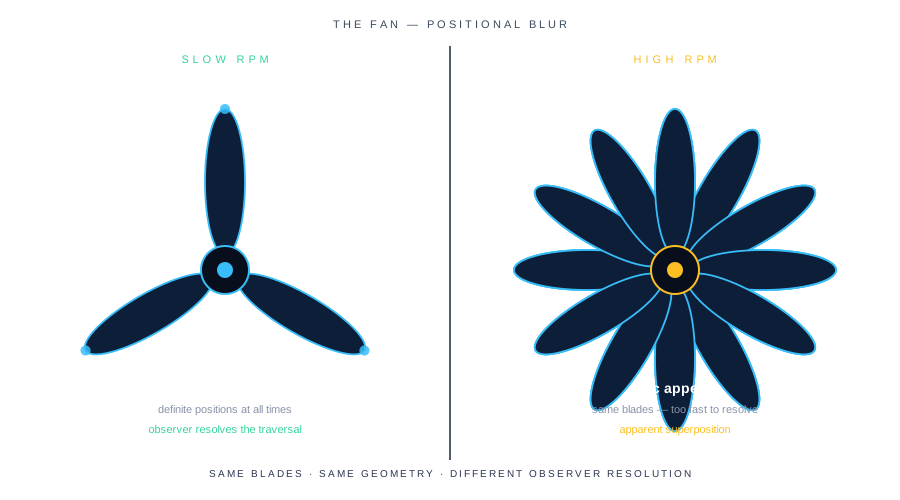
A fan has three blades. Run it at low speed — you see three blades. Run it fast — you see a disc. The disc is not a new ontological object. The disc is the measurement instrument (your eye, your camera shutter) failing to resolve the traversal.
Copenhagen made the category error of promoting the disc to fundamental reality. It said: at high speed, the fan is a disc. The blade positions are undefined until you stop the fan — until you measure.
The MPRC thesis is the opposite. The blades have definite positions at all times. The disc is what you see when your sampling rate is below the rotation frequency. Measurement is not creation. Measurement is the act of achieving sufficient resolution.
The Camera — Wave as Frozen Blur Trajectory
A camera with slow shutter speed photographing a moving object captures a blur line. That blur line was drawn by one object — one real path. At fast shutter speed the same object is frozen at one point. The blur and the frozen dot are the same object at two different temporal resolutions. The shutter speed selected what the observer sees — not what the object is.
This is wave-particle duality precisely mapped:
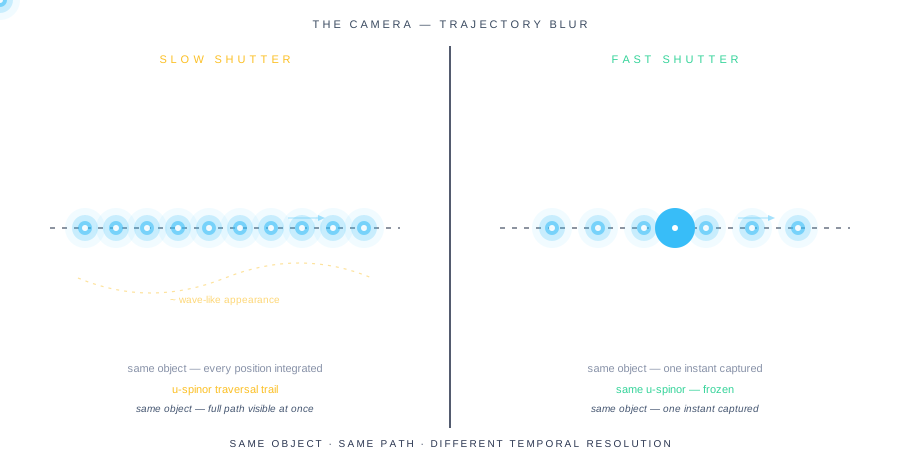
Wave nature and particle nature are not two properties of quantum objects. They are two projections of one FSL traversal — captured at different temporal resolutions. The observer's shutter speed selects which projection appears. The duality is in the instrument, not the object.
| Setup | Shutter Mode | What You See | What It Is |
|---|---|---|---|
| Screen only, no detector | Slow shutter | Interference wave pattern | Ring traversal geometry projected |
| Detector at slit | Fast shutter | Single particle position | Same ring traversal — frozen |
| Slow film camera, moving car | Slow shutter | Blur trail | One car — one path — full trajectory |
| High speed camera, moving car | Fast shutter | Car at one point | Same car — same path — one moment |
In MPRC Notation
The u-spinor state is <u|φ> — the spinor projected onto accumulated phase φ. Superposition depth is not a quantum number — it is a function of traversal frequency relative to the observer's resolution bandwidth. Different particles have different "blur radii" because their u-spinor frequencies differ geometrically — a prediction that is, in principle, testable.
The fan shows positional blur — one object at many apparent positions. The camera shows trajectory blur — one object whose path drawn at low resolution looks like a wave. Together they close the argument: duality is shutter speed, not ontology.
One Split Spinor — No Signal Required
Two entangled particles are not two independent objects that have somehow learned to communicate faster than light. They are one 720° spinor cycle that was split into two 360° half-cycles at the moment of creation. They separated in space. They did not separate in geometry.
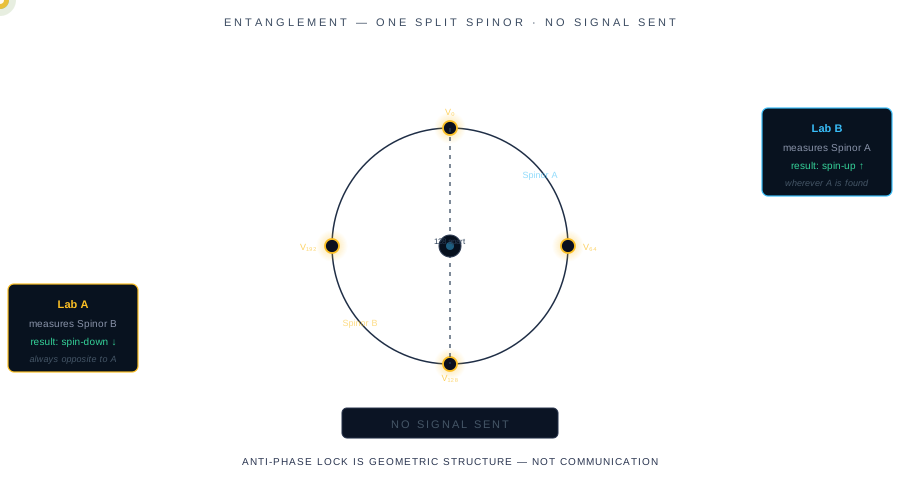
On the QH4 ring, anti-phase lock means the two spinor halves are always 128 states apart — exactly half the ring, always. When you observe A at position p, B is at p+128. Not because a signal was sent. Because that is what it means to be two halves of one cycle.
The Spin Flip — Precisely
Standard entanglement: measure spin-up on A, B is spin-down. In QH4 terms: spin-up is the upper arc traversal, spin-down is the lower arc. Anti-phase lock means if A is upper, B is always lower. The flip is not a response to measurement. It was always the structure.
What "Instantaneous" Means
The correlation is instantaneous not because information travels faster than light — but because no information travels at all. The lock was geometric. Observing one half does not inform the other half. It reveals what the geometry already contained. The left glove in a box does not signal the right glove across the room. The pairing was established before the boxes were opened.
Entanglement is not a property particles have — it is a property of incomplete spinor separation. The pair is one object that happens to occupy two locations. Nonlocality is not a feature of reality. It is a feature of treating one object as two.
FSL Objects Misclassified as Unreal
In standard QFT, virtual particles are declared "off-shell" — they appear to violate the energy-momentum relation E²=p²c²+m²c⁴ and exist only as internal lines in Feynman diagrams. They are given a special ontological status: real enough to mediate forces, unreal enough to never be observed.
The FSL thesis offers a more parsimonious account. The energy-momentum relation appears violated because the measurement framework requires the object to be below c. An FSL object — traversing QH4 at a speed that exceeds the observer's resolution — is not off-shell. It is off-bandwidth. The violation is not in the particle. It is in the fit of the framework to the phenomenon.
This removes a special ontological category without removing the phenomenon. Virtual particles mediate forces because they are real FSL objects. They cannot be directly detected because the observer cannot resolve them — the same reason you cannot photograph an individual blade of a running fan. The undetectability is a property of the observer, not a property of unreality.
| Property | Standard QFT | FSL Thesis |
|---|---|---|
| Ontological status | Real but unobservable — special category | Real FSL objects — same category as all particles |
| Energy-momentum relation | Violated — off-shell | Not violated — framework mismatch |
| Undetectability | Intrinsic — cannot in principle be observed | Observer bandwidth limit — resolution, not impossibility |
| Force mediation | Unexplained — "just how it works" | FSL traversal couples ring positions geometrically |
QKD as Proof the Geometric Lock Is Real
Philosophy without empirical anchor is speculation. This branch has one.
Quantum Key Distribution — specifically SPDC-based protocols — works by taking one high-energy photon, passing it through a nonlinear crystal, and splitting it into two entangled photons. In MPRC terms: one complete 720° spinor split into two 360° conjugate half-cycles. The anti-phase lock is artificially manufactured. The correlation is perfect at measurement. The security is geometric.
QKD is commercially deployed. It works. This is not a theoretical prediction — it is an engineering fact. And that engineering fact is only consistent with the geometric account. You cannot build a factory for "spooky action at a distance." You can build a factory for splitting spinors.
| QKD Fact | MPRC Implication Confirmed |
|---|---|
| Entangled pairs can be manufactured on demand | Anti-phase locks can be artificially created |
| Splitting one photon creates the correlated pair | One spinor split = two conjugate half-cycles |
| Correlation is perfect at measurement | Lock was structural, not probabilistic |
| Eavesdropping is always detectable | External resolution breaks the geometric lock |
| Security does not rest on computational hardness | Geometric invariance is not a hard problem — it is structure |
QKD proves the geometric lock is real and manufacturable. The fan analogy is not a metaphor. The split spinor is not a model. The factory exists. We are running it.
Where MPRC Stands Relative to the Field
This thesis is not unprecedented. A community of serious physicists has arrived at the same philosophical destination by different routes. Knowing where you stand relative to them clarifies what is original and what is convergent.
de Broglie–Bohm / Pilot Wave
Particles have definite trajectories at all times. Superposition is ignorance, not ontology. The wave function guides a real particle.
Nelson — Stochastic Mechanics
Quantum randomness emerges from real physical noise at the sub-quantum level. Measurement reveals — it does not create.
Gerard 't Hooft — Cellular Automaton Interpretation
Quantum mechanics emerges from deterministic sub-Planck dynamics. Superposition is coarse-graining over fast deterministic states. Nobel laureate. Explicit, serious, published.
Lee Smolin — Real Ensemble
Quantum states are real ensemble effects from similar systems across the universe.
Every member of this community says what: deterministic underneath, measurement reveals. MPRC says how: specifically the u-spinor traversing 256 QH4 states at FSL speed, with ring geometry producing the observable blur. 't Hooft identified the problem. MPRC identifies the engine.
What This Branch Does Not Yet Claim
The discipline of this framework requires explicit declaration of what is derived, what is staged, and what is open. The following are open — not because they are unanswerable, but because the derivation has not yet been completed.
| Question | Status | Path |
|---|---|---|
| Does the Uncertainty Principle follow from FSL bandwidth limits? | OPEN | Derive resolution limit from u-spinor traversal frequency vs observer tick rate |
| Do vacuum fluctuations map to QH4 cardinal vacuum nodes? | OPEN | <u|φ>=0 at {0,64,128,192} — structural stability, not random creation |
| What sets the FSL traversal speed for each particle type? | OPEN | Derivable from ring geometry — different particles, different u-spinor frequencies |
| Does superposition depth scale as a derived geometric ratio? | OPEN | Blur radius ~ ring traversal frequency / observer bandwidth — testable prediction |
| Can partial phase-lock (offset ≠ 128) be engineered? | OPEN | LQC generalization — controlled partial entanglement beyond binary flip |
These are not gaps in the philosophical argument. They are the next derivation targets. The philosophical argument stands on what is already built. The open questions are where it grows.
One Paragraph
Standard QM promotes observation artifacts to ontological status. Superposition is not a particle being everywhere — it is a traversal too fast to resolve. Entanglement is not spooky action — it is one split spinor read at two locations. Virtual particles are not off-shell — they are FSL objects outside our measurement bandwidth. The mechanism is the u-spinor on QH4. 't Hooft identified the problem. MPRC identifies the engine.
The Methodology
This branch is a staging record, not a submission. The discipline of this framework is to arrive at formal publication with proof already built — not to publish the philosophy first and hope the mechanism follows. 't Hooft published the philosophy thirty years ago. The mechanism is still contested. This document exists in the booklet until the empirical weight is sufficient that the philosophy arrives with proof, not ahead of it.