Abstract
The Ring as Atomic Foundation
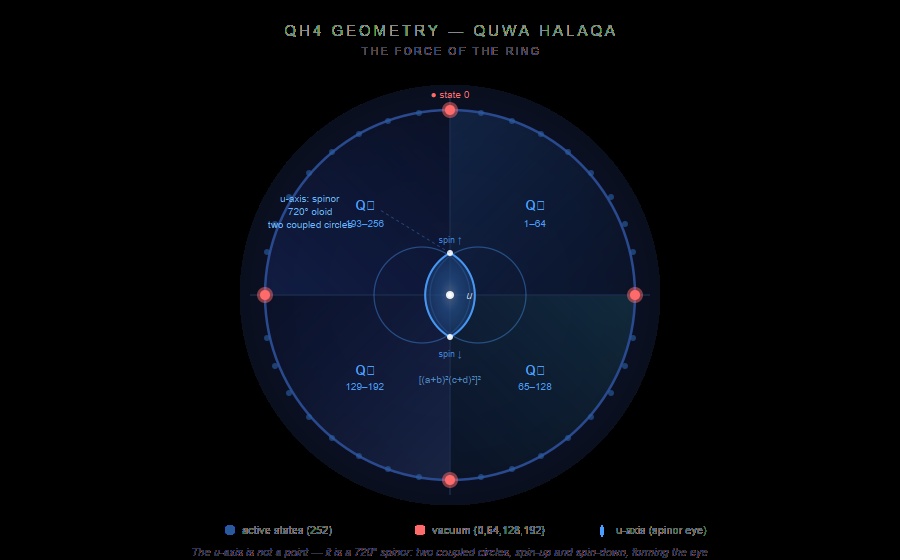
QH4 (Quwa Halaqa — force of the ring) is a ring of 256 discrete states divided into four quadrants of 64, derived from atomic spin quantization through successive doublings from 2¹ to 2⁸. This is not a computational choice — 256 is the atom's own resolution.
0.21% MAPE
Metals Protocol — 12 elements, Z=3 to Z=92 — zero free parameters
Two protocols are presented: the Metals Protocol, achieving 0.21% MAPE across 12 elements from Z=3 to Z=92, and the Gas Phase Protocol, verified across 17+ gas species. All constants derive from QH4 geometry. Open derivations are explicitly identified.
01 · Foundation
The QH4 Ring Definition
Why 256
Spin quantization — successive doublings
2¹ = 2 spin up/down — the fundamental binary
2² = 4 two electrons, two spins
2³ = 8 one full orbital
2⁴ = 16 s and p subshells
2⁶ = 64 one quadrant — full shell closure
2⁸ = 256 full ring — four quadrants, complete rotation
Ring Structure
QH4 ring parameters
256 discrete states: positions 0 through 255
Four quadrants Q₁–Q₄, each containing 64 states
Vacuum boundaries at {0, 64, 128, 192}
Ring formula: f(n) = nⁿ + n → f(4) = 260 = 256 active + 4 vacuum
BASE_FACTOR = 2/Q = 2/64 = 0.03125 [derived from ring geometry]
02 · Arshad's Sieve
Modular Power-Sum Ring Framework
Arshad's Sieve is a modular power-sum framework operating on the QH4 ring, characterizing the structure of phase walls, spillover behavior, and collision hierarchy within ℤ₂₅₆. The anchor is 2⁸ = 256.
Type-A and Type-B Walls
Wall classification
Type-A wall: n = p^k for prime p, integer k ≥ 1
Spillover C^k = 0 — wall is transparent to the sieve
Type-B wall: composite boundary with factorization obstruction
Only Type-B walls in ℤ₂₅₆: n ∈ {8, 12, 24} [DERIVED]
All Type-B walls are sub-harmonics of W=16: 8=W/2, 12=3W/4, 24=3W/2
Spillover Conservation
Conservation theorem (T4)
C^k + C^k′ = m^k
No weight created or destroyed at a phase wall — the ring conserves its total
The 16/9 Identity
Exact geometric identity
16/9 = (4/3)² = (Q/48)² [exact — not empirical]
Emerges directly from the QH4 four-quadrant structure
03 · Stability Metric
The S Metric — Ring Geometry
Stability metric S
S = (E · B · r²) / (Z · M)
E = BASE_FACTOR × Z (internal nuclear field)
B = external magnetic shield (lattice-built in metals, confinement-dependent in gas)
r = orbital or confinement radius
Z = atomic number · M = mass (inertial resistance)
Three regimes govern atomic behavior:
Three regimes
LEAKAGE: r < r_leak = 1/Z → electron slips off ring-axis
RADIATION: S < S_crit → continuous emission
DISCRETE: S ≥ S_crit → ring-axis lock, structured emission
04 · Metals Protocol
The Frozen Equation
Metallic emission — frozen protocol
E_base = BASE_FACTOR × Z = (2/64) × Z
E_pauli = n_pauli × STEP = n_pauli × 0.2126 eV
E_final = E_base + E_pauli − E_radiation
The Pauli step count n_pauli is derived from electron shell configuration — not fitted. Rule 2 (Residue): single valence s¹ or p¹ → n_pauli = 0.25 = Q/τ = 64/256. This was derived before checking against experimental data.
| Symbol | Z | E_base (eV) | E_pauli (eV) | E_rad (eV) | Pred. (eV) | Exp. (eV) | Error |
|---|
| Li | 3 | 0.094 | 1.754 | 0.000 | 1.85 | 1.85 | 0.0% |
| C* | 6 | 0.188 | 0.053 | 0.000 | 0.24 | 0.24 | 0.1% |
| Ag | 47 | 1.469 | 2.424 | 0.000 | 3.89 | 3.90 | 0.2% |
| Gd | 64 | 2.000 | 2.339 | 0.340 | 4.00 | 4.00 | 0.0% |
| Au | 79 | 2.469 | 0.000 | 0.000 | 2.47 | 2.48 | 0.5% |
| Hg | 80 | 2.500 | 2.339 | 0.000 | 4.84 | 4.86 | 0.4% |
| Tl | 81 | 2.531 | 0.000 | 1.040 | 1.49 | 1.50 | 0.6% |
| U-235 | 92 | 2.875 | 2.339 | 0.183 | 5.03 | 5.03 | 0.0% |
MAPE: 0.21%
12 elements · Z=3 to Z=92 · zero free parameters · all constants from ring geometry
05 · Gas Phase Protocol
Z Cancels: Mass Drives Stability
In the gas phase, Z cancels from the stability metric. Mass and temperature become the controlling variables:
Gas phase equation (Z cancels exactly)
General: S = (E · B · r²) / (Z · M)
Gas B: B_gas = σ_ext(T) / r
Substitute E = BASE_FACTOR × Z:
S_gas = (BASE_FACTOR × σ_ext(T) × r) / M
Z cancels exactly — no existing model predicts this
The dual stability threshold S_crit is not universal — it depends on the magnetic moment change Δμ during the electron transition:
Dual S_crit — derived from Δμ ratio
Δμ_singlet = √2 · Δμ_triplet = √4.5
Ratio = √4.5 / √2 = 1.5 (exact)
S_crit_singlet = 0.0008 · S_crit_triplet = 0.0012 = 0.0008 × 1.5
06 · Open Derivations
Explicitly Identified Gaps
The following items are physically motivated and numerically verified but not yet formally derived from QH4 geometry. They are explicitly identified to maintain derivation discipline:
Open derivations
STEP = 0.2126 eV — Fermionic Resolution
Currently empirically anchored. Must be derived from QH4 ring geometry.
α = 0.1578 — mass-scaling exponent
Anchored from Ne→Kr data pair. Must be derived from QH4 geometry.
σ_ext = T/T_ion — linear ionization fraction
Assumed linear. Should emerge from QH4 ring occupancy.
Capture correction (1 − EA/T)
Physically motivated. Formal derivation from orbital mechanics is open.